


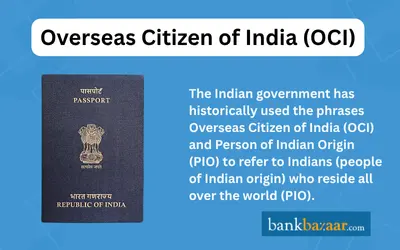
Overseas Citizen of India (OCI)
The Overseas Citizen of India (OCI) card gives foreign nationals of Indian origin a lifelong, multiple-entry visa for India, and the older Person of Indian Origin (PIO) card has been merged into it. You can now apply for an OCI card entirely online through the Government of India’s official OCI portal.

Overseas Citizens of India (OCI), a new program introduced in 2006, gave Indian-origin foreign nationals living abroad more benefits than the PIO program did. The PIO and OCI schemes were finally combined by the Indian government in 2015 to offer a single, more efficient option that serves as the government's outreach to persons of Indian origin.
What is a PIO Card?
A Person of Indian Origin (PIO) card is a kind of identification that identifies the holder as a foreign national of Indian origin who lives outside of India. This enables the Indian government to provide said individuals with a range of privileges that are only available to citizens of India.
Salient Features of PIO Cards
The various features of PIO Cards are mentioned below -
- Allows holders of PIO cards to remain in India for a period of 15 years without the need for a visa
- They are not required to register with the FRRO during their first 180 days in the country; after that, they must do so within 30 days
- They are eligible for all of the economic, educational, and financial benefits typically provided to NRIs.
Why was PIO Card Discontinued?
The PIO card scheme was rescinded on 9 January 2015 and amalgamated with the 2006-launched Overseas Citizen of India (OCI) scheme, a program that is identical to PIO. The term "Overseas Citizen of India" is preferred by the Indian government over the obviously foreign-sounding phrase "Person of Indian Origin."
Since the OCI scheme offered more features than the PIO program, it was clearly more appealing to foreign nationals of Indian descent, and a merger between the two programs was therefore inescapable. Existing PIO cards were offered the option to apply for an OCI card in addition to being automatically moved to the OCI system.
What is an OCI Card?
As mentioned above, the Overseas Citizen of India (OCI) card is bestowed upon people of Indian origin who also own a foreign citizenship. To qualify for an OCI status, the applicant must satisfy the following criteria:
- Foreign nationals who earned the eligibility for Indian citizenship as of 26 January 1950.
- Foreign nationals who were designated as Indian citizens at any point after 26 January 1950.
- Foreigners of Indian origin who previously were residing in a territory that seceded to the Indian sovereign Government after India’s independence on 15 August 1947.
- Minor children with parents/guardians who qualify per any of the conditions listed above.
- However, OCI Application forms can never be processed for foreign nationals from Pakistan and Bangladesh.
If you are a foreign national of Indian descent, the OCI card might be regarded as a crucial identifying document. The process for applying for an OCI card is straightforward and has been fully described in the section below.
Eligibility for OCI Card
Before you can fill up the OCI application form, consider the following criteria that must be satisfied for your application to be successful. You must either be a,
Foreign national:
- Who was a citizen of India at any point since the Indian constitution was formed (26 January 1950)
- Who held eligibility for Indian citizenship when the constitution of India was conceived
- Who was a citizen of territories that joined India after her independence on 15 August 1947
Children:
- Children, grand-children or great grand-children of people who were citizens of India at any point since the Indian constitution came into being on 26th January 1950.
- At least one of the parents in an Indian citizen.
Spouses:
- Wife/husband of an OCI/PIO cardholder or Indian citizen. Provided the marriage was legally registered and subsisted for at least 2 continuous years before application.
Exceptions:
• Citizens of Bangladesh and Pakistan cannot apply for the new OCI cards. The restriction also extends to the parents, grandparents or great-grandparents of such citizens.
• OCI cardholders no longer need to get the OCI booklet re-issued when a new passport is issued after the age of 20, but they must update the new passport details online on the OCI portal.
Foreign-origin spouses of Indian citizens or OCI cardholders are subject to prior security clearance by the competent authority in India. The restriction also covers persons whose parents, grandparents or great-grandparents are or were citizens of any other country notified by the Central Government, serving or retired foreign military or police personnel (with limited exceptions) and holders of diplomatic passports. Foreign nationals cannot apply for OCI in India while holding a tourist, missionary or mountaineering visa.
OCI Card Application Process
The Indian Government has simplified the entire OCI card application process, rendering it quick, timely and minus too much red-tape. The actual OCI application form can be segregated into two parts:
Part A - The applicant must fill and submit this form online.
Part B - This OCI card application is also submitted online, with the applicant’s photograph, signature and supporting documents uploaded on the OCI portal. No hard copy or printout of the application is needed.
The photograph must be square, at least 51mm x 51mm, with a front view of the head and shoulders on a plain light, non-white background. The photograph and the signature are each uploaded in JPEG format, not exceeding 200KB.
These photos must be of the dimensions of 35mm x 35mm in light non-white background.
Alongside the actual OCI application form, the following documents must also be submitted:
- Previous Indian passport. If unavailable, India-issued documents such as nativity certificate, birth certificate etc. can be submitted.
- Birth Certificate
- Valid foreign and current passport
- Proof of relationship if applicant applies on the basis of parents’ Indian citizenship
- Fee of US$275 or the equivalent in local currency, paid by demand draft at an Indian Mission or Post abroad, or the equivalent in Indian rupees, paid online when applying in India
Copies of the above documents are uploaded online, and the originals must be presented for verification at the Indian Mission, Post or FRRO.
Applications for registration as an OCI cardholder are accepted only on the online system, and the OCI booklet is normally issued in about 30 days from the date the application is acknowledged online.
Fingerprint and facial biometrics are mandatory for OCI applicants, except those above 70 years or below 12 years of age, and a personal interview is mandatory for new registrations, except for children below 12 years of age.
If OCI registration is not granted, US$250 of the fee is refunded, while the processing fee of US$25 is non-refundable.
Once your OCI registration is approved, you can generate and download the e-OCI card, a digital version of the OCI card, free of cost from the OCI portal. The e-OCI card does not replace the physical OCI card or change the validity or status of the OCI registration.
Step-by-Step Guide to Filling the OCI Form Online
- Go to the official OCI portal, of the Ministry of Home Affairs.
- Click on ‘User Register’ and enter your name, date of birth, nationality, email ID and mobile number as per your current passport.
- Read the instructions and guidelines and click ‘ok’.
- Fill in the CAPTCHA code and hit ‘enter’.
- Verify the one-time password (OTP) sent to your email ID, create a password with at least eight characters that includes an uppercase letter, a lowercase letter, a number and a special character, and then log in through ‘User Login’. Click on ‘Apply Online’ to start your application.
- For the place of submission, select India, and for Mission, select the FRRO (Foreigners Regional Registration Office) nearest to you.
- Fill out pages I and II of the OCI registration form with your details and click on ‘save’.
- Note the file reference number displayed on the screen.
- Verify the information provided and click on ‘submit’. You can select modify to make any changes.
- Upload the signature and photo of the applicant with the appropriate file form.
- Click on ‘Proceed to Part B’.
- Mark the boxes for the questions under ‘Other Details of Applicant’ and submit.
- Click on ‘Upload Documents’ and upload the required documents in PDF format.
- Click on the ‘Final Submit’ option.
- Pay the fee as applicable: applicants in India pay online, and applicants abroad pay by demand draft at the Indian Mission or Post. No printout of the application is required.
- Present the original documents for verification, and complete the biometrics and interview, at the Indian Mission, Post or FRRO where you applied.
- To check the application status, you can click on ‘Status Enquiry’ on the home page.
Things to Note While Filling the OCI Application Form
There are some things to note while filling out the application form to avoid any mistakes that could result in rejection. They are:
- The fields should be filled using BLOCK LETTERS.
- Any applicant below the age of 18 must place their left thumb impression in the signature box, as they cannot sign.
- Use only blue or black ink for signing and thumb impressions.
- The applicant must keep the original documents ready for verification.
- Ensure all supporting documents are uploaded online.
OCI registration is liable to be cancelled if it was obtained through fraud, false representation or concealment of any material fact.
Documents Needed for OCI Card Application
The mandatory documents needed to apply for an OCI card are as follows:
- Application submitted online through the OCI portal
- Copy of foreign passport
- Digital photograph and signature as per the photo specifications
- Copy of Naturalisation certificate, if needed
- Proof of address
The foreign passport must be valid for at least six months at the time of submission. Applicants who apply in India must also hold a long-duration visa, other than a tourist, missionary or mountaineering visa, valid for at least three months, along with a residential permit or registration certificate from the FRRO/FRO. Foreign birth and marriage certificates may need an apostille or attestation, and spouse applicants must also submit a registered marriage certificate.
OCI Cards and PIO Cards: Legal Differences
The OCI card (Overseas Citizen of India Card) and PIO (Person of Indian Origin Card) cards are two legal documents issued by the Government of India for foreign nationals of Indian origin. There are some notable differences between these two cards. They are:
OCI Card
- OCI cards have a lifelong validity
- OCI cardholders can own property except agricultural land/plantations.
- Provides more rights to the cardholders compared to PIO cards, excluding voting and political rights.
OCI cards issued to foreign-origin spouses of Indian citizens or OCI cardholders on or after 3 September 2025 start with a validity of five years, which can be extended to lifelong validity subject to scrutiny.
PIO Card
- PIO cards offer validity for only 15 years.
- PIO cardholders can own non-agricultural property and make investments in India.
- Provides fewer rights compared to OCI cards.
How to Convert PIO Cards into OCI Cards?
As previously mentioned, the Indian Government used two distinct card schemes that performed essentially identical roles as a way to identify and assist international nationals of Indian descent. Since PIO cards and OCI cards are nearly identical, it is logical to combine the two and simplify the process. This was accomplished in 2015 by amending the Citizenship Act. In addition, specific instructions were provided on the state of the PIO cards that were already in use. The Citizenship (Amendment) Act, 2015, which was approved by both chambers of parliament on March 4th, 2015, went into force on January 6th (the day it was initially suggested), and its main points are as follows:
- Existing owners of PIO cards will automatically be considered as OCI cardholders. They may obtain a separate, dedicated OCI card if required.
- People whose PIO application forms are being processed and accepted will automatically be transferred to the OCI system, where the former will be designated as the OCI application form.
- Applicants whose submitted PIO application forms have not yet been approved must reapply with a fresh OCI application form.
As can be gauged, maximum efforts have been made to ensure that existing PIO cardholders aren't sidelined or subject to difficult procedures to join the OCI fold. In summary, the PIO card is now completely discontinued and the OCI card takes its place for all intents and purposes.
Former PIO cardholders who wish to convert their PIO card into an OCI card can apply for the conversion through the OCI Miscellaneous Services on the OCI portal.
OCI Cardholders versus Indian Citizens
As coveted as the status of an OCI cardholder is, there are certain restrictions applicable alongside the plethora of privileges. All individuals who are seeking out the OCI card application form must be aware of the following limitations:
- He/she cannot stand in an election for the position of Vice President or President of India.
- The OCI cardholder is denied voting rights for elections.
- He/she cannot be appointed as a judge in Indian High Courts or Supreme Court.
- He/she cannot become the member of Rajya Sabha or Lok Sabha. Also, he/she is denied membership into any Legislative Council or Legislative Assembly pertaining to any Indian state.
- He/she cannot be appointed as a member of any public service initiative/posts that concern themselves with the affairs of the center or any state.
- The OCI cardholder cannot work for any public enterprise.
As most of these limitations are specific to law-making and public sector job opportunities in India, an average OCI cardholder will not be severely impacted. After all, the OCI status equates to earning a livelihood and residing abroad.
OCI cardholders need a special permit to visit any place that falls within a protected, restricted or prohibited area, and prior permission for research, missionary, mountaineering and journalistic activities. They cannot acquire agricultural land, a farmhouse or plantation property in India, and they must carry a valid passport and their OCI card while in India.
Summary
The Overseas Citizen of India (OCI) card gives foreign nationals of Indian origin a lifelong, multiple-entry visa for India, and the Person of Indian Origin (PIO) card has been merged into it. Eligible applicants can now register, fill in the OCI application, upload their documents and download a digital e-OCI card online, while keeping their original documents ready for verification. Check your eligibility, gather your documents and apply through the official OCI portal.
Read More About Other Passport Related Pages
- Indian Passport
- Apply for Passport Online
- Apply for Passport Offline
- Passport Forms
- Fill Passport Application Form
- Track Passport Application Status
- ECR ECNR Status
- OCI and PIO Card
- Passport Grievance and Feedback
- RTI and Passport
- Police Verification
- PSK Locations and Appointment
- Diplomatic Passport
- Passport Glossary Terms
- Dual Citizenship
- Police Clearance Certificate
- Passport Renewal, Changes, Reissue
- Change of Address in Passport
- Minor Passport
- Passport for Senior citizen
- Passport for Government Employee
- Tatkal Passport
- Student Passport
- Passport Renewal
- Passport Reissue
- Duplicate Passport
- Documents Required for Indian Passport
- Fees and Charges
FAQs on OCI & PIO Cards
1.What is an OCI card?
An OCI (Overseas Citizen of India) card is a registration issued by the Government of India to foreign nationals of Indian origin, and it works as a lifelong, multiple-entry visa for India. Holding an OCI card does not make the holder an Indian citizen.
2.What is a PIO card?
A PIO (Person of Indian Origin) card is an identification document that identified the holder as a foreign national of Indian origin living outside India. The PIO card scheme has now been merged into the OCI scheme.
3.Has the PIO card been discontinued after the OCI merger?
Yes, the PIO card scheme has been rescinded and merged into the OCI scheme. Existing PIO cardholders are deemed to be OCI cardholders.
4.Do existing PIO cardholders need to apply for an OCI card?
Existing PIO cardholders are automatically treated as OCI cardholders. They can still obtain a separate, dedicated OCI card through the OCI portal if required.
5.Who is eligible to apply for an OCI card?
Foreign nationals who were Indian citizens or were eligible to become Indian citizens on or after 26 January 1950, or who belonged to a territory that became part of India after 15 August 1947, are eligible for an OCI card. Their children, grandchildren and great-grandchildren are also eligible for OCI.
6.Can the spouse of an Indian citizen or an OCI cardholder apply for an OCI card?
Yes, the foreign-origin spouse of an Indian citizen or an OCI cardholder can apply for an OCI card if the marriage is legally registered and has continued for at least two years before the application. Such OCI applications are also subject to security clearance.
7.Can minor children apply for an OCI card?
Yes, minor children of persons who qualify for an OCI card can apply for OCI registration. Minor children with at least one Indian citizen parent are also eligible for an OCI card.
8.Who cannot get an OCI card?
Foreign nationals from Pakistan and Bangladesh cannot get an OCI card, and the restriction extends to persons whose parents, grandparents or great-grandparents are or were citizens of these or other notified countries. OCI registration is also not available to certain categories such as holders of diplomatic passports.
9.How do I apply for an OCI card?
You apply for an OCI card online by registering on the official OCI portal, filling in the application, and uploading your photograph, signature and documents. The detailed OCI application steps are given in the step-by-step guide above.
10.Do I need to submit a paper application for an OCI card?
No, the OCI application is submitted online and no hard copy or printout of the application is needed. You must still present the original documents for OCI verification at the Indian Mission, Post or FRRO.
11.Which documents are needed for an OCI card application?
An OCI application needs a foreign passport, proof of Indian origin or relationship, a birth certificate, proof of address, and a naturalisation certificate where applicable. The complete OCI document list is given in the documents section above.
12.What are the photograph and signature requirements for an OCI application?
The OCI photograph must be a good-quality, square, front-view photograph on a plain light, non-white background, uploaded along with the signature in the format specified on the OCI portal. The exact OCI photograph specifications are given in the application process section above.
News on Overseas Citizenship of India
India Moves Citizenship Services Fully Online with Updated OCI Rules
The Government of India has introduced new Citizenship (Amendment) Rules, 2026, which bring major changes for Overseas Citizen of India (OCI) applicants. A key update is that the entire OCI process has now been made completely online, removing the need for physical paperwork and in-person submission. Applicants will now complete registration, renewal, and other related services through a digital platform. It has been clarified that OCI status does not mean full citizenship and does not give political rights like voting or holding public office, and it can be cancelled if rules are violated. Minors are also not allowed to hold both Indian and foreign passports at the same time. The OCI scheme, started in 2005, continues to allow eligible persons of Indian origin lifelong entry to India, but people with links to Pakistan or Bangladesh are still not eligible.

Disclaimer
Credit Card:
Credit Score:
Personal Loan:
Home Loan:
Fixed Deposit:


Copyright © 2026 BankBazaar.com.