


Online GST Registration - Process, Eligibility & Benefits
GST registration is mandatory for businesses with turnover exceeding Rs.40 lakh (Rs.20 lakh in north-eastern states) or Rs.10 lakh in special categories, and must be obtained within 30 days of meeting the threshold.
The process is free, conducted entirely online, and grants a permanent GSTIN valid until cancellation or surrender. Voluntary registration is also available for eligible businesses below the threshold.

What is GST Registration?
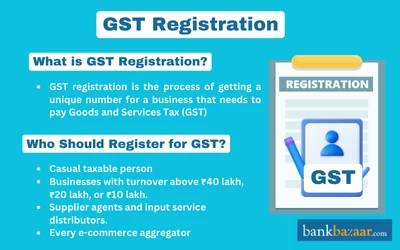
GST registration is the process under the Goods and Services Tax (GST) law by which a business or professional obtains a GSTIN (Goods and Services Tax Identification Number).
Once registered, the taxpayer can charge GST, issue GST‑compliant invoices, file returns, and claim input tax credit. Operating a business that meets registration criteria without a GSTIN is an offence under GST law and can attract penalties.
Rule 14A Registration (Small Business Scheme)
Small businesses with expected monthly output tax liability not exceeding Rs.2.5 lakhs may opt for Rule 14A registration, which offers simplified compliance requirements. This category provides relief from maintaining detailed records if turnover stays within specified limits. Aadhaar authentication is mandatory for Rule 14A registration.
Who Must Register Based on Turnover / Eligibility to Register for GST
GST registration becomes mandatory when your aggregate turnover in a financial year crosses specified thresholds. These threshold limits were revised as part of GST Council recommendations to reduce compliance burden on small businesses. These limits differ for suppliers of goods and services and vary between normal and special category states:
- Normal Category States: Goods suppliers: Rs.40 lakh – Services providers: Rs.20 lakh
- Special Category States: Goods suppliers: Rs.20 lakh – Services providers: Rs.10 lakh
Note: The term ‘aggregate turnover’ includes all taxable supplies, exempt supplies, exports, and inter‑state supplies made by the same entity across India.
Examples of State Thresholds
The normal category states follow the higher limits, some special category states like Arunachal Pradesh, Manipur, Mizoram, Nagaland, Sikkim, Tripura, and Uttarakhand apply the lower Rs.20 lakh (goods) / Rs.10 lakh (services) thresholds, reflecting regional economic considerations.
Who Must Register Regardless of Turnover
Registration is mandatory irrespective of turnover for certain categories:
- Inter‑state suppliers of goods or services
- Non‑Resident Taxable Persons and Casual Taxable Persons
- Persons liable under reverse charge mechanism
- E‑commerce operators and those supplying through them
- Input Service Distributors (ISDs) and agents of a supplier
Even freelancers must register if their turnover exceeds the applicable service threshold (generally Rs.20 lakh in normal states or Rs.10 lakh in special states) or if they provide OIDAR services (online information and database access services).
Why Threshold Limits Matter
Understanding where your business sits relative to these limits helps avoid penalties. For example, a penalty of 10% of tax due (minimum Rs. 10 000) can apply for failing to register once a threshold is crossed.
Online GST Registration Process
The step-by-step procedure that individuals must follow to complete GST Registration is mentioned below:
Step 1: Visit the official GST portal and Click on the 'Register Now' link which can be found under the 'Services' tab
Step 2: Select 'New Registration' and Fill the below-mentioned details
GST Registration – Part A
- Under the 'I am a' drop-down menu, select 'Taxpayer'.
- Select the respective state and district.
- Enter the name of the business.
- Enter the PAN of the business.
- Enter the email ID and mobile number in the respective boxes. The entered email ID and mobile number must be active as OTPs will be sent to them.
- Enter the image that is shown on the screen and click on 'Proceed'.
- On the next page, enter the OTP that was sent to the email ID and mobile number in the respective boxes and Click on 'Proceed'.
- You will be shown the Temporary Reference Number (TRN) on the screen. Make a note of the TRN (Which helps in further Steps).
Note: The TRN remains valid for 15 days. Applicants must complete Part B and submit the application within this period, or the TRN and all entered information will be purged from the system.
GST Registration – Part B
Step 1: Now, Visit the GST portal again and click on 'Register' under the 'Services' menu.
Step 2: Select 'Temporary Reference Number (TRN)'. Now, Enter TRN number and the captcha details. Click on 'Proceed' button.
Step 3: You will receive an OTP on your email ID and registered mobile number. Enter the OTP and click on 'Proceed'.
Step 4: The status of your application will be available on the next page. On the right side, there will be an Edit icon, click on it.
Step 5: In the Next Step, There will be 10 sections which must be filled and has to submit the required documents. The list of documents that must be uploaded are:
- Photographs
- Business address proof
- Bank details such as account number, bank name, bank branch, and IFSC code.
- Authorisation form
- The constitution of the taxpayer.
Submit the documents and move to Next Step.
Step 6: Visit the 'Verification' page and check the declaration, then submit the application by using one of the below mentioned methods:
- By Electronic Verification Code (EVC). The code will be sent to the registered mobile number.
- In case companies are registering, the application must be submitted by using the Digital Signature Certificate (DSC).
- By e-Sign method. An OTP will be sent to the mobile number linked to the Aadhaar card.
Once completed, a success message will be shown on the screen. The Application Reference Number (ARN) will be sent to the registered mobile number and email ID.
Note: You can check the status of the ARN on the GST portal.
Deemed Approval: If the tax officer fails to act within 3 working days of application submission (if no deficiencies exist) or within 7 working days of receiving your clarifications/documents, your application shall be deemed approved automatically.
Key Benefits of GST Registration
Some of the main benefits of GST registration are mentioned below:
Benefit | Explanation |
Eliminates the Cascading Effect of Tax | GST integrates multiple indirect taxes and allows input tax credit, removing the ‘tax on tax’ effect and reducing costs. |
Transparency in Taxation | Uniform rates and GST-compliant invoices make tax payments clear, predictable, and easy to track. |
Reduces Tax Evasion | Mandatory reporting and input tax credit tracking encourage compliance and better accountability among suppliers. |
Composition Scheme for Small Businesses | Businesses with turnover ≤ Rs.1.5 crore (Rs.75 lakh for special states) can opt for a fixed-rate tax scheme with simplified filing; input tax credit not available. |
Higher Registration Thresholds | Normal states: Rs.40 lakh for goods, Rs.20 lakh for services; Special states: Rs.20 lakh for goods, Rs.10 lakh for services reduces compliance burden for small businesses. |
Reduced Number of Compliance Filings | Replaces multiple taxes with a single GST framework; unified returns simplify reporting and reduce administrative costs. |
Uniform Treatment for E-commerce Operators | Standardised rules for online marketplaces and sellers eliminate previous inconsistencies between states. |
Formalisation of the Unorganised Sector | Brings more businesses, especially textiles and construction, under formal compliance and accountability. |
Improved Logistics and Supply Chain Efficiency | Removes interstate check-post barriers, enabling faster movement of goods and more efficient supply chains. |
*Special category states: Himachal Pradesh, Uttarakhand, Jammu & Kashmir, Arunachal Pradesh, Manipur, Mizoram, Nagaland, Sikkim, Tripura.
Documents Required for GST Registration
The following is the list of documents required for GST registration:
- PAN card
- Aadhaar card
- Bank account information
- Proof of address
- Digital Signature
- Photographs
- Articles of Association/Memorandum of Association
- Certificate of incorporation issued by Ministry of Corporate Affairs
- Proof of appointment of authorised signatory
- For LLP, the registration certificate/LLP Board resolution
- Bank Account Filing Timeline: Bank account details are no longer mandatory at registration time. However, they must be provided within 45 days of registration grant through a non-core amendment application. You will be prompted to file this amendment when you first login to the GST portal after receiving your GSTIN.
New Online GST Registration Fees
- No charges are levied to complete the GST registration process.
- In case businesses do not complete the registration process, 10% of the amount that is due or Rs.10,000 will be levied. In the case of tax evasion, 100% of the amount that is due will be levied as a penalty.
- Once the relevant documents have been uploaded, an Application Reference Number (ARN) will be sent via SMS and email to confirm the registration.
How to Get a GST Number?
In order to get the GST number follow the simple steps:
Step 1: Visit the official GST Portal
Step 2: Select 'Services' tab and Click on 'Registration'.
Step 3: Now, Click on "New Registration" and enter all the requested details like valid email address, mobile number and a PAN for the business.
Step 4: Click on Proceed after submission of details to get the GST Registration Number.
Application Deadline: You must submit your GST registration application within 30 days from the date on which you become liable to register. If you apply after 30 days, your registration will be effective from the date of approval rather than from the date you became liable.
How to Check GST Registration Status Online
- Visit GST official portal
- Click to 'Services' > 'Registration' > 'Track Application Status'.
- Enter your ARN number and Captcha code. Next click on the SEARCH button.
- Finally, you will receive any of the following GST registration status on your screen:
- Provisional status
- Pending for verification status
- Validation against error status
- Migrated status
- Cancelled status
Different Types of GST Registration
Under the GST Act, GST Registration can be of various types. You must be aware of the different types of GST Registration before selecting the appropriate one. The different types of GST Registration are:
- Normal Taxpayer: Most businesses in India fall under this category. You need not provide any deposit to become a normal taxpayer. There is also no expiry date for taxpayers who fall under this category.
- Casual Taxable Person: Individuals who wish to set up a seasonal shop or stall can opt for this category. You must deposit an advance amount that is equal to the expected GST liability during the time the stall or seasonal shop is operational.
- Composition Taxpayer: Apply for this if you wish to obtain the GST Composition Scheme. You will have to deposit a flat under this category. The Input tax credit cannot be obtained under this category.
- Non-Resident Taxable Person: If you live outside India, but supply goods to individuals who stay in India, opt for this type of GST Registration. Similar to the Casual Taxable Person type, you must pay a deposit equal to the expected GST liability during the time the GST registration is active.
- SEZ Unit: Apply as separate business vertical. Requires approval order and period of validity (maximum 10 years). Registration will be cancelled automatically if not renewed after validity expiry.
- SEZ Developer: Must apply separately with Letter of Approval/Permission, designation of approving authority, and validity period (maximum 10 years). Separate registration required from other business units outside the SEZ.
- Corporate Insolvency (IRP/RP): Interim Resolution Professionals (IRPs) or Resolution Professionals (RPs) managing corporate insolvency proceedings may register on behalf of Corporate Debtors in each state where proceedings are undertaken, using Corporate Debtor PAN and CIN. Notification of appointment must be uploaded.
How to Download GST Certificate Online?
The procedure to download the GST Registration Certificate is mentioned below:
- Step - 1: Visit Official Site
- Step - 2: Click on 'Login'.
- Step - 3: On the next page, enter the username and password.
- Step - 4: Click on 'Login'.
- Step - 5: Next, click on 'Services'.
- Step - 6: Click on 'User Services'.
- Step - 7: Select 'View/Download Certificates'.
- Step - 8: On the next page, click on 'Download'. The certificate will have details of the tax transactions.
Penalty for Not Registering or Late Registering Under GST
If you do not pay tax or pay a lesser amount than what is due, the penalty that is levied is 10% of the due amount (in case of genuine errors). However, the minimum penalty is Rs.10,000.
If you have not registered for GST and are deliberately trying to evade tax, the penalty levied is 100% of the due tax amount.
Who is Exempt from GST Registration?
The below-mentioned individuals and entities are exempt from GST registration:
- Businesses that manufacture supplies that come under reverse charge.
- Activities that do not come under the supply of goods or services. Examples of such activities are the sale of a building or land, funeral services, and services provided by an employee.
- Businesses that make non-GST/ non-taxable supplies. Examples are aviation turbine fuel, electricity, natural gas, high-speed diesel, and petrol.
- Businesses that make exempt/ nil-rated supplies.
- Businesses that fall under the threshold exemption limit.
- Agriculturists.
Aadhaar Authentication & E-KYC Requirements
Aadhaar authentication is mandatory for most GST registrations and can be completed via two routes: OTP-based authentication (recommended, link valid 15 days) or biometric authentication at designated GSKs. Applicants not opting for Aadhaar authentication must undergo photo capture and document verification at their jurisdiction's GSK within 15 days of TRN generation. Rule 14A registrations require Aadhaar authentication as mandatory.
Voluntary GST Registration
Businesses below the compulsory registration threshold may voluntarily register for GST to claim input tax credit. However, once voluntarily registered, the registration cannot be cancelled for a minimum of one year from the effective date. Voluntary registration is particularly beneficial for businesses making B2B supplies or exporters seeking to claim ITC on inputs.
Effective Date of Registration
The effective date of GST registration depends on timing of application submission: If your application is submitted within 30 days of becoming liable, registration is effective from that liability date. If submitted after 30 days, registration is effective from the approval date by the tax officer. This distinction is important for determining when you can legally start collecting GST.
FAQs on Online GST Registration Process
1.Is GST registration mandatory?
Yes, GST registration is mandatory and should be obtained by the taxpayer if the business turnover exceeds the threshold limit.
2.Who can register for the composition scheme under GST?
The Composition scheme can be opted for by small taxpayers who want to lower tax rates under GST and lesser compliance. A business with an aggregate turnover below Rs 1.5 crore and Rs.75 lakh for North-eastern states and Himachal Pradesh, can be applied for composition scheme under GST.
3.Is GST registration free?
Yes, GST registration can be done online at Nil charges.
4.What is the deadline for registering under GST?
A business that is required to register for GST must apply for registration within 30 days after satisfying the criteria. Prior to starting a company, casual taxpayers and non-resident taxpayers must register for GST.
5.How long is a GST registration valid?
There is no expiration date for a GST registration. Thus, it remains valid until surrendered, suspended, or cancelled. Only non-resident taxable individuals and casual taxable individuals have a validity term that is set by the authorities when the GST registration certificate is issued.
6.Is an individual who does not have a GST registration allowed to collect GST?
No, GST can be collected only by those who have registered for GST. Individuals who are not registered for GST are not permitted to claim an input tax credit for GST paid.
7.When will I receive my GST number?
The complete GST registration procedure, including receiving the GST number, takes 7 to 10 working days.
8.What happens when the GST registration is completed?
You will receive a GST registration certificate as well as a valid GSTIN after the GST registration procedure has been completed. You are now entitled to file GST returns and claim the input tax credit.
9.My company has locations in two states. Do I have to register individually for GST in these states?
Yes, you must register for GST separately in each of the two states where your company conducts business.
10.What if the GST application is rejected?
If your GST application was rejected, you will be given the opportunity to respond to the rejection letter. However, if you desire to reapply, you must first wait for a final rejection which may take about 10 days.
11.What is the threshold limit for GST registration?
Businesses that sell goods and have a turnover of more than Rs.40 lakh (or Rs.20 lakh in the northeastern and hill states) must register as regular taxable persons. The threshold in the case of service providers is Rs.20 lakh (Rs.10 lakh for northeastern and hill states).
12.Is bank account mandatory for GST registration?
A bank account is not required initially but must be provided within 45 days after registration.
13.Can I surrender my GST number?
Yes, you can surrender the GST number. However, you can do so only after one year from the date of registration.
News about GST Registration
GSTN Advisory: Biometric Authentication Update
As of March 3, 2025, Goods and Services Tax Network (GSTN) has introduced biometric authentication for GST registration, allowing company promoters and directors to complete the process in their home state. Previously, they had to undergo OTP verification or visit a GST Suvidha Kendra (GSK) in the company’s registered state.
This facility is available for Public and Private Limited Companies, Foreign Companies, and Unlimited Companies. Eligible individuals can select a GSK in their home state via email, but once chosen, it cannot be changed. The facility is not mandatory and currently available in 33 states and UTs, excluding Uttar Pradesh, Assam, and Sikkim. After email confirmation, a slot booking link is provided, subject to availability at the chosen GSK. The process includes photo capture and biometric authentication at GSK. If already completed, repetition is not required. It is advisable for the Primary Authorized Signatory to ensure biometric authentication is done before visiting the GSK.

Annie Jangam is a financial writer with a unique background in biotechnology and eight years of genomics research experience, culminating in 6 international publications. She combines her analytical and communication skills to simplify complex financial concepts, delivering precise and creatively engaging content in the fintech industry. She covers various financial products such as banking, insurance, credit cards, tax, commodities, and more. Outside of the financial realm, she dabbles in poetry. Her extracurricular passions include organizing events like One Billion Rising and Human Rights Day. She is committed to the equality of all people, a principle rooted in her Christian faith. Annie strives to embody the values of faith, hope, and love in both her work and her life.

Disclaimer
Credit Card:
Credit Score:
Personal Loan:
Home Loan:
Fixed Deposit:


Copyright © 2026 BankBazaar.com.