


Steps to Develop a Healthy Saving Habit
When you first start earning money, you might not have thought much about saving (and even if you did, there wouldn’t be much left from your meagre salary), but when you start getting hikes and when you see your friends investing big, you might have tried to start saving some money of your own.

This is not an easy task for many of us due to various reasons. Here are some steps that you should take immediately to develop a healthy habit of saving.
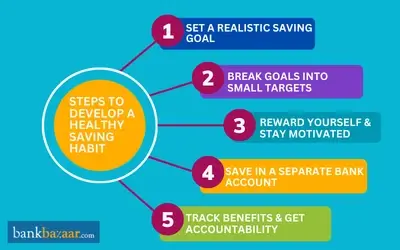
Step 1: Make a realistic saving goal
Do not jump into the deep end and make an unachievable goal, especially if you have not been trying and failing at saving for years. If you make a goal that you cannot achieve, you will unnecessarily put yourself out there to be demotivated. Start small. For best results make a goal for six months or a year. Decide upon an amount that is realistic in this period so the fact that you can achieve it if you try will keep you motivated.
Step 2: Break the goal into smaller targets
Once you have thought about what a realistic amount and period is for you, the next step is to break this goal into smaller targets. For instance, if your goal is to save Rs. 12,000 in six months, break this into smaller period of time and amounts. Thus, instead of thinking of saving Rs 2,000 per month for six months, think about saving Rs. 500 per week. Smaller targets are more easily achievable and thus will keep you motivated. This is to create the habit of saving. Once you become accustomed to the habit, you can aim higher and increase the goal.
Step 3: Reward yourself
Treat yourself when you achieve a target, be it a daily/weekly/monthly target. The reward-punishment psychology will ensure that your behavior of saving is reinforced with the reward. Soon you will be on the way to being intrinsically motivated to save.
Step 4: Open a separate bank account with no ATM, Debit card or Online Banking facility
This may sound a little farfetched, but think about it, what better way to make sure that you are saving money unceasingly? The new bank savings account will give you a clear picture of how much you are saving. There will be no confusion as to how much you saved each month, and if you are able to keep up with your targets.
Further, the lack of ATM card, debit card and online banking facility will make it that much more difficult for you to spend from that account. So chances are that you will leave it untouched unless you need the money for an important cause.
Step 5: Keep a daily motivator
You have to keep yourself motivated when it comes to saving. You can do this by placing a motivating statement or two in places that you will see every day, many times a day, such as the mirror or in your wallet. This will give you the daily motivation that you need.
Step 6: Benefits of saving
Start a journal. Spend a few minutes daily jotting down all of the benefits that you will receive once you have achieved your goal. Make sure that you also write down how it makes you feel to be able to save and reach your daily/weekly targets. Writing down the benefits will motivate your sub conscious mind and in return help you stick to the routine of saving.
Step 7: Ask a buddy/ family member to help you stay on track
Having someone to keep you motivated when you are not feeling very motivated is a sure way to make you stick to the routine. Pick someone that you are close to, authoritative (if need be) and are sure to help in keeping you motivated. Don’t pick someone who is not close to you because they may not be as comfortable telling you the truth or pushing you when you need it the most.
Sticking to these steps will ensure that you are well on your way of saving that money like you have always wanted to. It may be difficult in the beginning, but you will soon get used to saving and it will become a habit and a natural way of living.
Other Useful Reads :
- Savings Bank Accounts v/s Current Accounts
- Which Type of Account Is Usually the Most Liquid?
- Banking Mistakes You Cannot Afford to Make
- What is Inactive or Dormant Bank Account?
- NRE Savings Account v/s NRO Savings Account
- Should I Go for One Bank or Many When it Comes to Keeping my Accounts
- Top 7 Smart Money Saving Tips
- Top 8 Money Management Tips Even During Job Loss
FAQs on Steps to Develop a Healthy Saving Habit
1.What are the 5 common ways to save money for the future?
Save money by tracking expenses and following the 50/30/20 rule 50% for needs, 30% for wants, and 20% for savings. Maintain financial discipline, open a recurring deposit, and invest in government schemes, retirement plans, gold, or mutual funds. Build an emergency fund and create multiple income sources to boost savings. Also, repay high-interest debts and credit card bills on time to avoid penalties.
2.What are the important steps to develop a Healthy Saving Habit?
To develop a healthy saving habit, consistently track your expenses and stick to your budget. Avoid unnecessary spending and set aside a fixed amount each month for savings or investments. Set realistic goals, stay flexible, and use spending limits or an accountability partner if needed. If you slip, don’t be hard on yourself just get back on track.
3.What is the best way to save money as a teenager?
The best way for a teenager to save money is to spend less than your income. Open a minor or joint savings account, track income and expenses, and set realistic savings goals. Set aside a fixed amount regularly and avoid credit cards. Save more by thrifting, using student discounts, taking part-time jobs, and staying focused on your goal.
4.What are the common saving tips that can help me save money?
Save money by unsubscribing from unused plans or sharing them with family and friends. Use offers, cashback, shop during sales, thrift, and wait 24 hours before making purchases to avoid impulsive spending. Cut food and travel costs by cooking at home and using public transport or carpooling. You can also use free memberships, employee discounts, and try DIY projects to reduce expenses.

Disclaimer
Credit Card:
Credit Score:
Personal Loan:
Home Loan:
Fixed Deposit:


Copyright © 2026 BankBazaar.com.